After a year’s silence, I write to memorialize the following:

  • Every note that Rebecca Clarke wrote for performance and left in a performable state has now been published—admittedly, by six different publishers, but a Gesamtausgabe is a Gesamtausgabe, no matter how you slice it, and hello, Bach and Beethoven.
  • Every note that Clarke wrote for voices and left in a performable state has now been published and recorded.
  • Every note that Clarke wrote for instruments and left in a performable state has now been published, and virtually every bit of that has been recorded.
  • The remainder, consisting of a single counterpoint exercise and two fragments, is in the works.

Details may be seen here, here, and here. I rest my case.
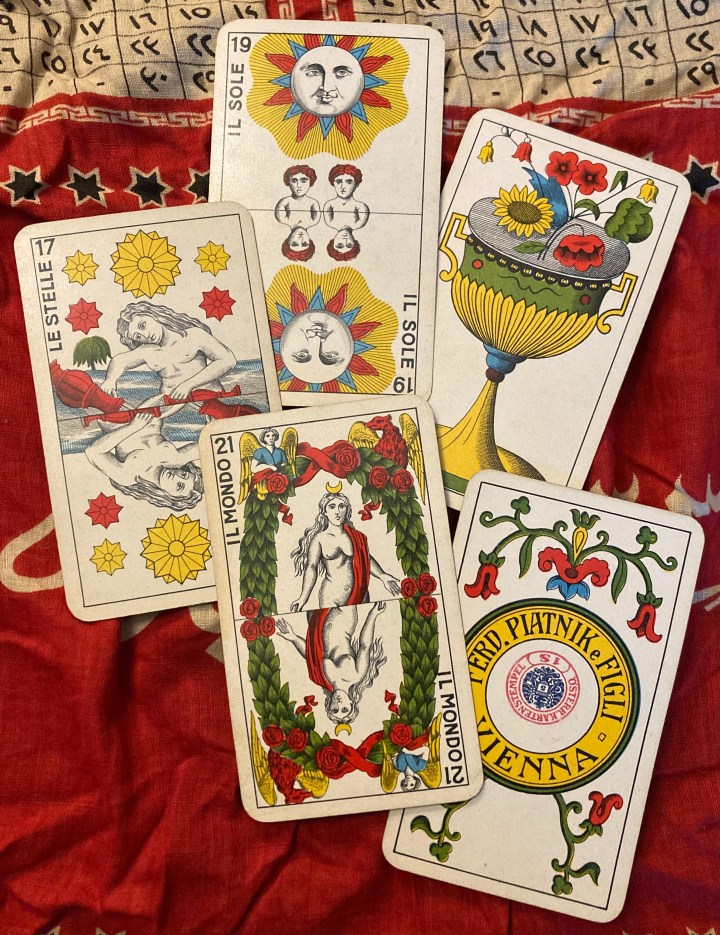
Favorable cards from Clarke's tarot deck
Favorable cards from Clarke’s tarot deck (Ferd. Piatnik e Figli [Ferd. Piatnik & Söhne], Vienna, n.d.),
which she was given as a gift on 19 September 1928 and used to read Ravel’s fortune a month later—one of several experiences that ultimately led her to put away the cards for good, “as there were things I was simply not meant to know.”

Unless we’ve missed something, every note that Rebecca Clarke wrote for the viola, her chosen instrument, is now in print, with the publication of her arrangements of works by Percy Grainger, Stanley Marchant, and Sir Hubert Parry, and her cadenza to the “Handel”/Casadesus Concerto in B Minor, by Sleepy Puppy Press. Print and digital editions are available.

These are terrific pieces in their own right—Grainger’s Sussex Mummer’s Christmas Carol is familiar in its original form, for cello or violin, but Parry’s Sarabande and Marchant’s setting of Londonderry Air, both originally for violin, will be welcome re-additions to the repertoire—and they’re of particular interest in showing how Clarke displayed her gifts as a player, while demonstrating the distinctive qualities of the instrument. To that end, Clarke’s markings have been painstakingly reproduced, including her fingerings, bowings, and timings. Caroline Castleton’s crisp introduction lays all this out for you.

Clarke stood nearly six feet tall in her prime, and she had exceptionally long, elegant arms and fingers, as shown in the cover art. She deliberately undermarked her publications, so as not to bind violists with different physical attributes, which means that you should take the markings in this album seriously, but not literally—”for interest only,” as they say. Still, it’s a fascinating set of insights into Clarke’s own style and methods, and thus uniquely valuable.

Also, barring some unexpected discovery, you now have Rebecca Clarke’s Absolutely, Totally, Positively 100% Complete Works for Viola, so what are you waiting for?

We’ve been Tweeted! We don’t think we’ve ever been Tweeted before. We’ve certainly never been Tweeted by King’s College, Cambridge, even though we did meet Sir David Willcocks one time.

Check it out here, and be sure to follow the link to our posting on The Seal Man, which is really quite brilliant and stimulating, if we do say so ourselves.

Proud Songsters: English Solo Song, the recording driving all this, is really quite brilliant, too. See the links in our Shop.

Reluctant as one is to promote oneself, I stumbled into a very nice conversation with the Carrefour Chamber Music Project, of Shreveport, Louisiana, and we all thought you might enjoy having a look at the result. Plus you get to see more of my workroom than perhaps you may ever have expected to see, including my Stetson, duly acquired and hand-shaped in San Antonio, Texas, and the U.S. Army Sweetheart pillow my Daddy sent my Mama while he was posted at Camp Blandings, Florida, during World War II.

Carrefour’s posting of the video is here, and we’ve added it to our Gallery here. Both postings have links to other activities of this impressive operation.