The New York Review of Books published a review-essay about Leah Broad’s Quartet in their issue dated October 5, 2023 (published online in mid-September), and while the bulk of the reviewer’s attention went to Dame Ethel Smyth—whose success at eating all the oxygen in any room she’s let into remains unparalleled—a number of statements were made about Rebecca Clarke, virtually all of them untrue, and most of them plainly lifted, not from Dr. Broad’s book, but from Wikipedia.

Well, this wasn’t our first rodeo, so we weren’t particularly surprised, even though the reviewer is Distinguished Professor of Music History and Dean Emeritus at a well-known American university, and probably wouldn’t tolerate such behavior from his students. What stuck in our craw, however, was not the ahistorical and overwhelmingly reductive treatment of Clarke’s output and publishing-history, but the final as-if silver lining—”Fortunately her works are being championed and the unpublished pieces brought into print by the recently formed Rebecca Clarke Society at Brandeis.”—giving credit to a scofflaw outfit that has been the principal impediment to the publication of Clarke’s works for the last two decades.

Clearly, this required a response, so we contacted the Review immediately with the relevant facts. This yielded a slight correction, deleting “and the unpublished pieces brought into print” from the body of the review, and adding a blink-and-you’ll-miss-it line at the end, reading “An earlier version of this article misstated the purpose of the Rebecca Clarke Society at Brandeis.” Well, no, actually—both versions of the article misstated the facts of the matter across the board, so we submitted a formal letter to the editor, and were told that it had gone to the relevant department for consideration. A month of near-silence passed, followed by a month of absolute silence, followed—after one final query on our part, just this morning—by news that space could not be found.

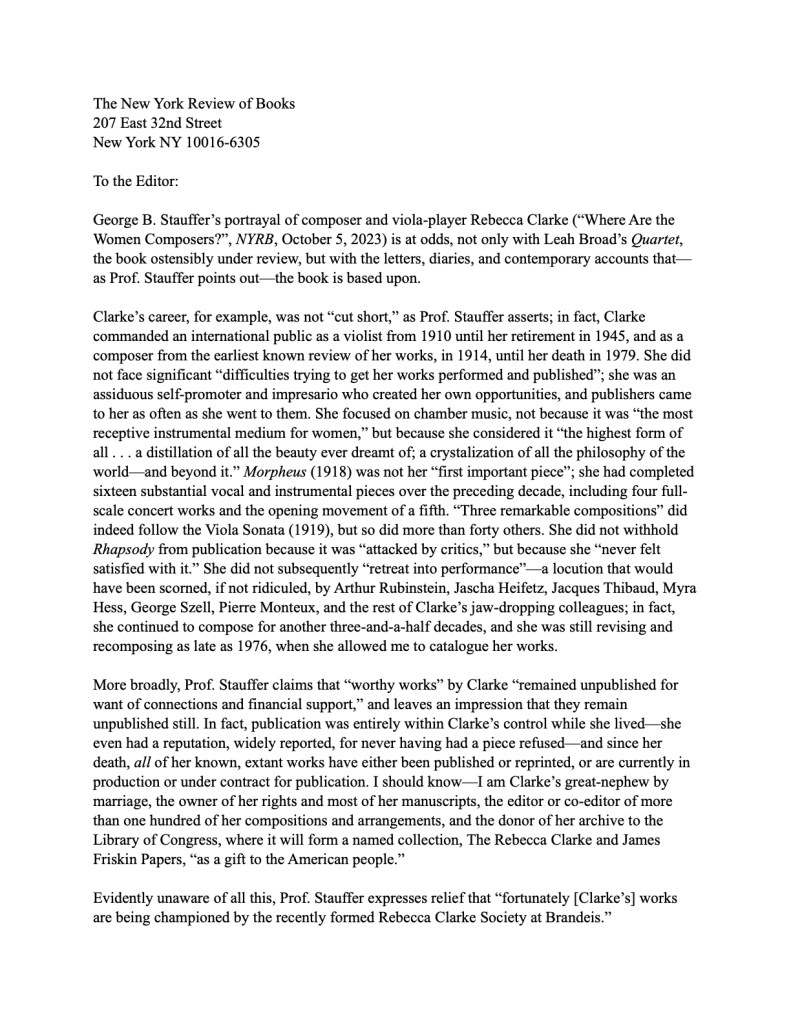
Be that as it may, people are still being misled, so here’s our letter, as submitted on October 19, 2023. We realize that our circulation doesn’t quite equal that of the New York Review, but we do make every effort to keep the public record straight, and to find space for the truth.
The Online Concert Hall of Pontiac Enchanté, the terrific chamber-music series in Luskville, Québec, that holds forth in a half-converted horse-barn—gorgeous music-room made out of the original hay-loft upstairs, horses still making their own kind of music downstairs—has graced us with back-to-back performances of Clarke’s Binnorie: A Ballad and Midsummer Moon, and you can’t get much farther apart than that: the former is a bone-chilling tale of envy, murder, and revenge, while the latter boasts one of the best nightingales in the business.

We’ve raved about Binnorie in these pages once before, but last Sunday’s performance by Meghan Lindsay and Carson Becke, adds a whole new level of terror, as well as unexpected flashes of tenderness and sad irony. The text, as Clarke set it, is here. To repeat out original warning, the piece is more than two Liebestods long, and at least five times as intense, so you will need to allow a minimum of sixteen minutes without interruption: close the door, shush your companions, turn off your devices, and allow ample time to recover from Lindsay’s overwhelming delivery of the final curse—like the composer, she does not hold back. Here it is. Remember: you have been warned.

Earlier today, Sofia Yatsyuk and Suren Barry did a lovely job with Midsummer Moon, at the 20:43 mark of a rich and deeply rewarding program that also features works by Bloch, Tailleferre, Fauré, and Smyth. Clarke and Bloch were good friends, and she always freely admitted how much she admired his music, and occasionally allowed as how she’d cribbed from him a time or two. What’s interesting here, though, is the contrast between them, highlighting Clarke’s tightness of focus, lightness of touch, economy of means, and absolute command of the listener’s attention.

Donation requested, and absolutely appropriate.

Faber & Faber just announced their acquisition of two books by Leah Broad—the “dazzling young musicologist” at Christ Church, Oxford, whose work you’ve read about in these pages several times before—the first of which is Quartet, a group biography of four “trailblazing” women who “changed British music”: Ethel Smyth, Dorothy Howell, Doreen Carwithen, and (you guessed it) Rebecca Clarke.

Word of the deal broke only day-before-yesterday—you can read The Bookseller’s breathless take on it here—and Quartet won’t be published until sometime in 2023, COVID permitting. Still…

We hasten to bring it to your attention for one very important reason: Quartet will be the first extended publication on Clarke and her music since Daniela Kohnen’s pioneering monograph, first published in 1999 (see our “Learn More” page). Dr. Broad’s book is written for a wider audience, but with equal rigor, and, of course, the range of documentary sources available to scholars—especially contemporaneous journals, trade-magazines, and the all-important concert-advertising—is exponentially larger now than it was twenty years ago. Quartet will set Clarke in the context of the professional world where she actually lived, breathed, worked, and drew her own life’s meaning.

So stick a pin in this, and we’ll keep you posted as things develop. In the meantime, check out Dr. Broad’s article on Ethel Smyth, just published in The Guardian, for a sample of her fair-minded, even-handed, thoroughly lively style, and for evidence that she is refreshingly willing to admit that great icons can be less than they claim to be—or than we might want them to be—and still be fundamentally decent, real people who are interesting and exciting to know.