After a year’s silence, I write to memorialize the following:
Every note that Rebecca Clarke wrote for performance and left in a performable state has now been published—admittedly, by six different publishers, but a Gesamtausgabe is a Gesamtausgabe, no matter how you slice it, and hello, Bach and Beethoven.
Every note that Clarke wrote for voices and left in a performable state has now been published and recorded.
Every note that Clarke wrote for instruments and left in a performable state has now been published, and virtually every bit of that has been recorded.
The remainder, consisting of a single counterpoint exercise and two fragments, is in the works.
Details may be seen here, here, and here. I rest my case.
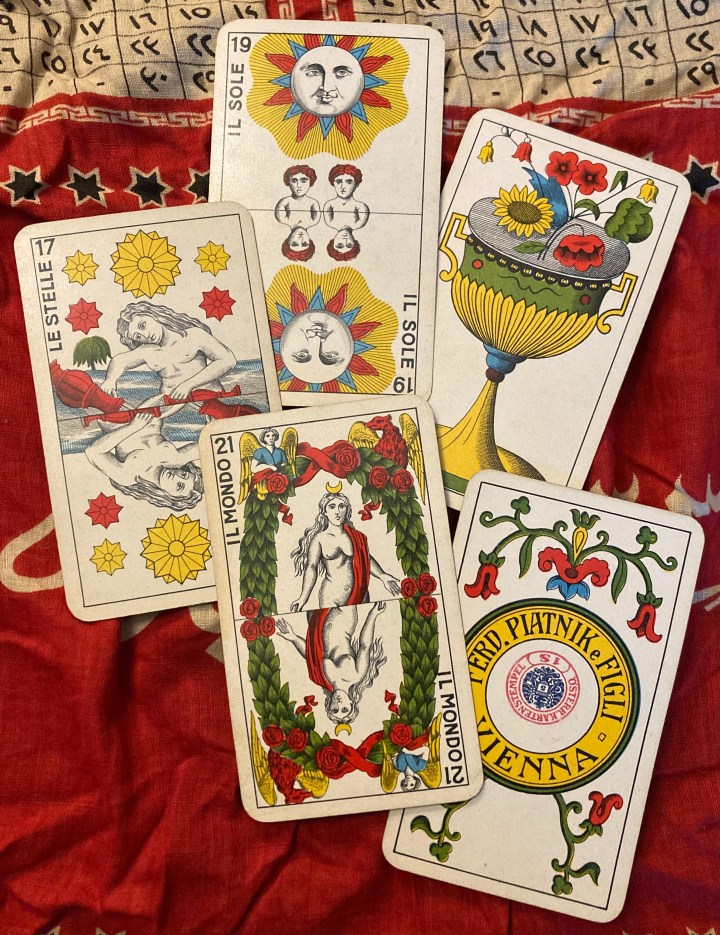
Favorable cards from Clarke’s tarot deck (Ferd. Piatnik e Figli [Ferd. Piatnik & Söhne], Vienna, n.d.), which she was given as a gift on 19 September 1928 and used to read Ravel’s fortune a month later—one of several experiences that ultimately led her to put away the cards for good, “as there were things I was simply not meant to know.”
What we believe to be the last of Clarke’s extant pieces for violin have just been published by Sleepy Puppy Press.
They can’t be dated with certainty, but circumstantial evidence suggests an association with the early years of World War Two, when Clarke was marooned in the United States, cut off from her funds, unable to secure a visa to return home to London, and forced to camp out with her two brothers and their families. She contributed as she could, in part by giving her niece Magdalen violin-lessons.
The duet “For 2 Violins” dates from 1940—or so Clarke recalled decades later—although the autograph continues with the beginning of another duet with the lower voice in bass clef, similar to a piano-piece that she wrote while studying counterpoint with R.O. Morris, in London, in the early 1930s.
The unaccompanied solos Lament and Jig/March are a total mystery. I stumbled across them a few years ago, jotted down on yellow tablet-paper, folded down small, and inserted into one of Clarke’s books, where they marked a passage about Debussy’s experience at the beginning of World War One. Their purpose remains unknown—as does their instrumentation, although an unaccompanied violin seems like just the thing for a jig, and perfectly plausible for a lament.
Since all three pieces can be associated, however tangentially, with the time when Clarke was giving violin-lessons, and can serve, quite nicely, as instructional materials for that instrument, we decided to publish them together, providing optional accompaniments for Lament and Jig/March—carefully modeled after Clarke’s late style, by Alan and Andrew Bell—in order to facilitate use in the studio and in recital. The pieces can be used, singly or together, in a variety of ways: as two short solos and a more extended duet; as a set of three violin-duets; as a pair of violin-and-piano duos; or in any combination, mix and match.
Admittedly, this goes far beyond anything Clarke ever stipulated, but we couldn’t help feeling that these pieces were just too attractive to be put before the public as bare technical material. so we’ve tried to present it both ways: if you want (or require) the Urtext, you have it here, as Clarke left it; and if you want it in a form that wouldn’t be out of place in your next recital, you have that, too.
Available in print and digital formats, with a full set of demonstration videos either way.
Rebecca Clarke (right) with her niece Magdalen Thacher Clarke (second from left), at a family wedding in London, 3 August 1938
Clarke’s Daybreak, for voice and string quartet, originally published in 2012, has just been reissued—freshly engraved, with an updated introduction and a cover-design that captures something of the piece’s overwhelming sensuality—by our friends at Sleepy Puppy Press. Details on our Shop page, and on Sleepy Puppy’s website (here for the print edition, here for the digital).
The text is John Donne’s aubade “Stay O sweet, and do not rise!”—which, in case you’ve forgotten, is not just a morning-song but a morning-after song, in which two lovers are not only still in bed, but wound very tightly in one another’s embrace.
Little else needs to be said, except that you should immediately knock yourself out with the glorious performance by Nicholas Phan and Brooklyn Rider, here or at either of the Sleepy Puppy links above.
Cover art: Detail from a portrait of Rebecca Clarke, 21 July 1925, by Langfier Ltd., London, Rebecca Clarke and James Friskin Papers, Music Division, Library of Congress
Unless we’ve missed something, every note that Rebecca Clarke wrote for the viola, her chosen instrument, is now in print, with the publication of her arrangements of works by Percy Grainger, Stanley Marchant, and Sir Hubert Parry, and her cadenza to the “Handel”/Casadesus Concerto in B Minor, by Sleepy Puppy Press. Print and digital editions are available.
These are terrific pieces in their own right—Grainger’s Sussex Mummer’s Christmas Carol is familiar in its original form, for cello or violin, but Parry’s Sarabande and Marchant’s setting of Londonderry Air, both originally for violin, will be welcome re-additions to the repertoire—and they’re of particular interest in showing how Clarke displayed her gifts as a player, while demonstrating the distinctive qualities of the instrument. To that end, Clarke’s markings have been painstakingly reproduced, including her fingerings, bowings, and timings. Caroline Castleton’s crisp introduction lays all this out for you.
Clarke stood nearly six feet tall in her prime, and she had exceptionally long, elegant arms and fingers, as shown in the cover art. She deliberately undermarked her publications, so as not to bind violists with different physical attributes, which means that you should take the markings in this album seriously, but not literally—”for interest only,” as they say. Still, it’s a fascinating set of insights into Clarke’s own style and methods, and thus uniquely valuable.
Also, barring some unexpected discovery, you now have Rebecca Clarke’s Absolutely, Totally, Positively 100% Complete Works for Viola, so what are you waiting for?
It is with great joy—and in a state of dazed half-belief—that I announce the following:
All of Rebecca Clarke’s remaining vocal music—the early songs that she wrote as an uninstructed amateur, her first experiments as a fledgling professional, her fabulous duets—will be published by ClarNan Editions, an imprint of Classical Vocal Reprints, in a series of volumes co-edited with Nicholas Phan, the brilliant Grammy-nominated tenor who has done so much for Clarke’s music in the concert-hall.
All of Clarke’s remaining music with strings—including the ensemble-version of Chinese Puzzle that she made for the Aeolian Players, and the violin teaching-pieces she wrote for one of her nieces—will be published by Sleepy Puppy Press, along with a volume for viola comprising Clarke’s arrangements of pieces by other composers, and her cadenza for the “Handel”/Casadesus concerto, co-edited by Caroline Castleton, whose doctoral work at the University of Maryland promises to transform our understanding of Clarke as a performer.
If current projections hold, this means that all of Clarke’s compositions known to exist in a completed state—excluding only sketches, drafts, and exercises—will have been published by the end of 2023. Thus, Clarke will join the likes of Bach, Beethoven, Brahms, Berlioz, and Palestrina in having virtually every note she ever wrote put before the public, but with one vital distinction: Clarke’s de-facto Complete Works Edition will exist, not as a monumental set that only large reference collections can afford to acquire, but as a series of practical publications available through normal commercial channels to the widest possible range of musicians, students, and music-lovers.
Once these projects are completed, along with a giant piece of research that I am determined to finish on the same schedule, I will be donating Clarke’s manuscripts and papers, and those of her husband, the great pianist James Friskin, “to the United States of America for the benefit of the American people and inclusion in the Library of Congress“—a phrase in the deed of gift that overwhelms me every time I think of it—where they will form a named collection, The Rebecca Clarke and James Friskin Papers, to which the aforementioned research project will serve as a key.
In 1982, Clarke’s heirs assigned her rights to me with the goal of “promoting such rights as a memorial,” and in the intervening forty-one years much ink has been spilled as to whether or not I have done so. Like Clarke, I am content to let my work speak for itself.
Library of Congress James Madison Building, Washington, D.C., exterior view, from corner of Independence Avenue and 2nd Street, by Carol M. Highsmith, 2007, Library of Congress Prints and Photographs Division, LOT 13908 (ONLINE)
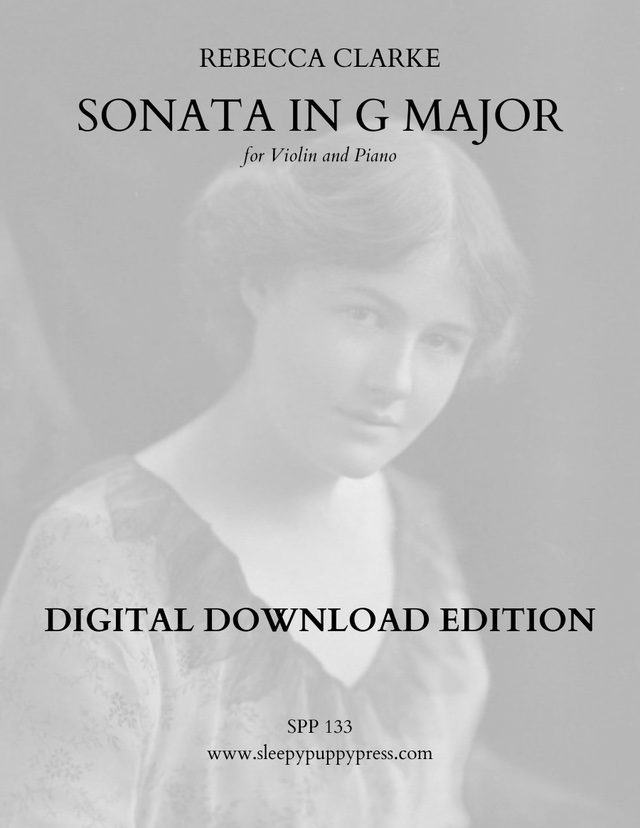
A quick news-flash to mark the release of Clarke’s violin sonatas in digital-download editions, with print editions to follow, as promised in our previous post.
We cannot sufficiently stress the joy that this moment brings, with all of Clarke’s big concert works now published and in general circulation throughout the world. (And—nudge, nudge, wink, wink—there are plans in place for the rest.)
When we started this whole Rebecca Clarke thing, we promised that we would not clog your in-box unduly, but somehow a silence lasting eighteen months seems excessive. We can only plead pandemic, and more tsouris than—well, as we say here in Brooklyn, you shouldn’t ask.
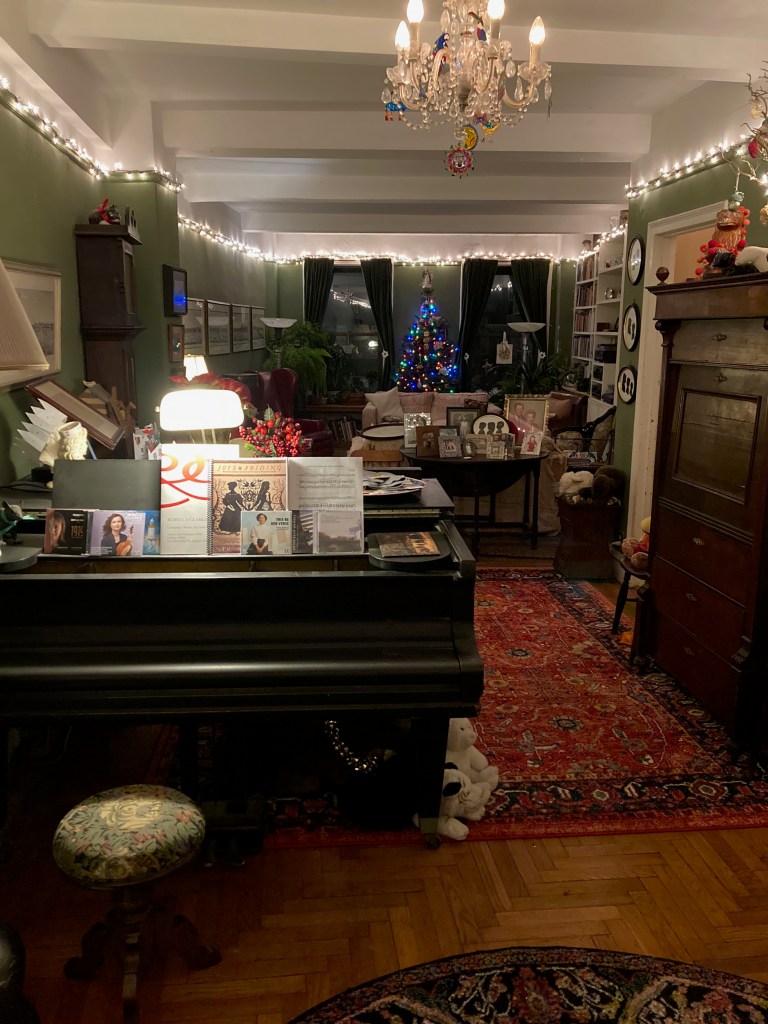
Still, as we set out the customary Christmas-Eve display of the year’s Clarke publications and recordings across the music-rack of the piano where she composed Dumka (and you’ll forgive the stuffed animals peeking out everywhere, as the latest generation was turning out in force the next morning, Dumka or no Dumka), we were struck with what an extraordinarily productive year 2022 had turned out to be, what with all of Clarke’s piano-music, and half of her vocal duets, being published and recorded in tandem—and if you don’t think vocal duets are a tough market to crack, try it, and then come back and tell us about it.
There were too many things to put face-out all at once. In addition to the larger items, which you can find out about on our Shop page, there were a compelling account of Clarke’s Viola Sonata set amongst some of the other great viola-works of 1919, a mesmerizing take on the related Untitled, outstanding performances of Tiger, Tiger and The Seal Man, and a terrific matchup of Cortègewith Liszt’s Piano Sonata in B minor (trust us, this makes perfect sense, once you’ve heard it).
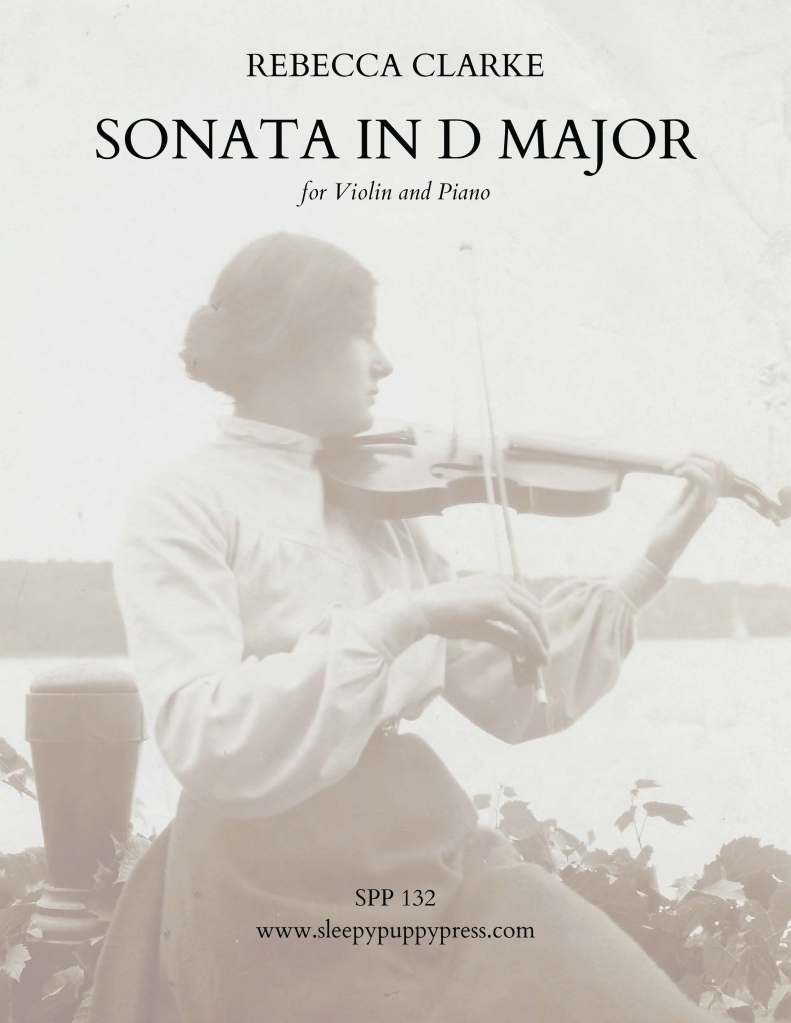
And if you look at the picture closely enough, you can just make a out a harbinger of what promises to be a blowout 2023: the first proofs of Clarke’s Violin Sonata in D, which Sleepy Puppy Press is bringing out very early in the New Year, along with the substantial opening movement that Clarke wrote towards an intended Violin Sonata in G (see our Shop page to pre-order either or both). These poor pieces—her first full-scale concert pieces, composed at the Royal College of Music in London, around 1909—were first scheduled for publication more than twenty years ago, but have been sidelined again and again, first by a corporate restructuring leading to a comprehensive shift in strategy, then by three serious illnesses, a lengthy hospitalization, a massive blizzard, one actual death, a corporate acquisition of uncertain scope and import, and finally by a contractual ambiguity that could only be resolved by the passage of time—and that’s just the publishers!
Suffice it say that Sleepy Puppy, which did such stellar work anthologizing the borderline-sublime slow-movement of the Sonata in D, is doing a bang-up job with the whole lot. These are wonderful pieces. Their publication will not only add two important works to the teaching- and concert-repertoires, but will mark the availability of all of Clarke’s major concert-works in print.


 Rebecca Clarke